
May round-up
Everything I've been reading and writing in the last month

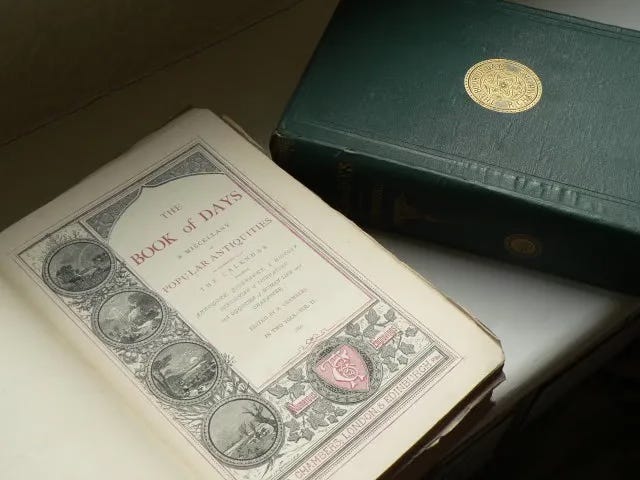
Things I’ve picked up from The Book of Days
Maypoles, the authors felt in the mid-1860s, would only by that time be remembered by very old people, and the crowning of a May Queen is more obsolete even than that. I was aware that maypoles and suchlike things had been revived in the 20th century but I hadn’t realised they’d been in abeyance for so long. It’s a shame they didn’t also revive the custom, still around in the early 19th century, for milk-maids to dance around a flower-wreathed cow to the strains of violin or clarinet. Although the cows may not agree.
Morris dancing, that other staple of a ‘traditional’ English Spring festival, is not even English, and what’s worse, it came to England in around the 16th century from France of all places, where it was known as Morisque. ‘It has been supposed to be originally identified with the fandango’ says the Book of Days, and that line in Bohemian Rhapsody has taken on a whole new slant. Not that I knew what the fandango was, either.
While we’re on Morris dancing, an amusingly modern tale of a comic actor doing a strange thing in public with much fanfare and getting a book out of it, only this was in 1599. The celebrated William Kemp morris-danced from London to Norwich that year, attracting large crowds and sometimes having members of the public dancing with him for a while. When he was done, he wrote a pamphlet about it. The Book of Days doesn’t specify what prompted the adventure.
Machiavelli, notorious 16th century author of The Prince which has remained a useful handbook on how to be a sneaky, conniving politician, also wrote a successful comedy play called Mandragola (The Mandrake). The Book of Days authors commented that The Prince ‘was conveniently denounced for its immorality by men whose true aversion to it sprang from its exposure of their arts’
Sir James Thornhill was paid 40 shillings per square yard for painting eight pictures of the life of St Paul on the interior of the cupola at St Paul’s Cathedral. He seems to have painted a lot of ceilings, grand staircase murals etc, and the great and the good appear to have preferred to pay him by the square yard (‘like a plasterer’ as the Book of Days says), and even then at as small a rate as they could get away with.
Haggis was immensely popular in England according to the 1653 book English Housewife, whereas at the time of writing the Book of Days it was ‘barely compatible with an Englishman remaining at table’, and it remains to this day very much a Scottish dish.
As recently as 1782 a member of the Royal Society (the one that Elon Musk is a fellow of) was working on alchemy and was awarded a degree by Oxford University for his ‘achievement’ of transmuting mercury to gold. When asked to repeat his demonstration for the benefit of the Royal Society itself, James Price apparently realised he’d made a mistake in his previous experiments, swallowed poison, and died.
I had never considered that St Pancras was a person, and not just a railway station. Apparently martyred in 304, aged 14.
In 1796 when Edward Jenner proved that his smallpox vaccine worked, the worst anti-vaxxers were inside the medical schools, campaigning against him and ready to swear blind that his use of the cow-pox was turning children into cow-human hybrids.
Other reading and listening
At the start of the month I read Across France in War Time by W Fitzwater Wray, which I’ve already written about and I gave a link there to the scanned-in copy via Warwick University that you can explore online. It’s a fascinating account of a cyclist’s short adventure through France a few weeks after the outbreak of the First World War. It also alerted me to the fact that a Channel Tunnel had been begun in 1880 and abandoned, which I had never realised before.
After last month’s Time Traveller’s Guide to Restoration Britain, I finally got round to reading Life in Stuart England by Maurice Ashley which came from a library sale and I think has been on my bookshelf for over 30 years without being read (same bookcase, many different flats and houses). I had an idea that I would read a bit of it, figure it was an older (1967), dryer version of the book I’d just read, and chuck it in the ever-waiting charity shop bag. Obviously there was a lot of crossover, but I enjoyed it1 and was by then so immersed in 17th century England that I went straight on to Daniel Defoe’s A Tour Through the Whole Island of Great Britain2 which I bought at a charity shop last year, and downloaded Celia Fiennes Through England on a Side Saddle in the Time of William and Mary which is from around the same time and kept being quoted in the two history books.
I then went back to Anthony Trollope after a bit of a break — still finding good novels of his that I haven’t read yet. I picked up a paperback of John Caldigate in the local Oxfam bookshop just after Christmas and it’s certainly up there with Orley Farm and He Knew He Was Right, i.e. I couldn’t hand on heart say it was his absolute best work but it’s damned close. The titular hero is a young man who gets into scrapes as a student, and heads out to Australia as a gold miner in order to try and make some money to pay off his debts. There he comports himself no worse than many other young men, but when he returns to England and marries his sweetheart, a woman in Australia claims he’s already married to her. Written and set in the 1870s, I can imagine it was pretty shocking stuff when it came out (bigamy! perjury! sex before marriage!), and good grief it was tense.
Earlier in the year I read a slim volume I’d picked up at a charity shop, about the 1826 weavers’ riots in the West Riding of Yorkshire — I don’t recall if I mentioned it at the time, possibly not as I imagine it’s not of wide appeal. However, I’ve come across this wonderful presentation of the story, which most people don’t know about, even if they’ve heard of the Luddites of the previous decade, and I couldn’t resist sharing it.
Writing
Having a week off work at the end of May, despite the heatwave I wrote a couple of thousand words of the second of my 1920s-set Wodehouse-esque comedic novels set in Northumberland3. This new one is (for now, at least) called Hebburn and a Spot of Fishy Business, the protagonist of both books being one Archibald Hebburn — think Bertie Wooster with an extra brain cell but an equal propensity for getting accidentally engaged.
I finally finished another wholly new story for the Midsummer special spoken word and music night I’ll be at on June 21st. I will share them here next month, once the event has taken place. Now I just need to remind myself how to read aloud in front of an audience while remaining audible and dynamic. Wish me luck.
I did laugh at this bit though, “The more sophisticated and cultured people of the south were reluctant to visit or settle in the north, as they still are today.”
Published in the 1720s but some of it is apparently based on his travels over the preceding 40 years i.e. there’s reason to believe that the presentation of it as a series of recent journeys with particular stated routes is just a convenient structure to write it in
The first one, Hebburn and the Follies of Youth, remains unpublished as yet
I want to read the books when they come out! And would love a link to listen to the spoken word event after the fact, if that becomes available.